Inside Passage Gates: Lessons, Crossings, and Quiet Coves
Some mornings on the Inside Passage remind you that the ocean has its own sense of humor. Today was one of them—calm as glass in Von Donop Inlet while the outer channels whipped themselves into a froth.
Von Donop Inlet is an anchorage tucked inside Ha’thayim Marine Provincial Park. It’s our final stop on Cortes Island after completing a full loop. My first visit here left me baffled: how could the outer channels be blustery while this bay stayed glass‑calm? Leaving the inlet that day, I still didn’t fully understand the contrast—but I knew it was real. Today is the same story: serene water in here, bluster outside, and this time I don’t question it.
As you head north from Bellingham up the Inside Passage, there are several sections that require careful timing and planning—“gates,” as the Waggoner Cruising Guide calls them. Each one demands a different mix of skill, experience, and respect. We’ve passed several already and have a couple more ahead.
• Rosario Strait
Where Pacific Ocean water enters the Strait of Juan de Fuca, it splits in multiple directions, and one of those flows north through Rosario Strait, forming the eastern edge of the San Juan Islands. It doesn’t feel like a big deal anymore, but I vividly remember my first spring crossings in the early 2000s. For a beginner sailor, Rosario is a rite of passage.
• Clearing Customs into Canada
Always an adventure—very different from airport customs. Core your apples before entering Canuck land. We usually check in at Bedwell Harbor or Sidney. A Nexus pass would simplify things, but we haven’t braved the appointment vortex yet. This year’s entry was uneventful, and we motored on to Ganges for the provisions we couldn’t bring across the border.
• Dodd Narrows
The first northbound flow from the Strait of Juan de Fuca is Haro Strait, which eventually splits into Trincomali Channel and Boundary Pass. Dodd Narrows sits at the northern tip of Trincomali, just before Nanaimo, and can run up to 9 knots. Our personal limit in a keelboat is about 2 knots—anything more is asking for trouble. The tide tables and planning tools have never failed us, though we’ve certainly misread them once or twice, and those moments stick with you.
Nanaimo also has a great chandlery, and this time we were on the hunt for a patch kit for our slow‑leaking dinghy—don’t they all leak? Eventually we’ll stop somewhere dry for a couple days and fix it properly. Until then, we just top up the pontoon as needed.
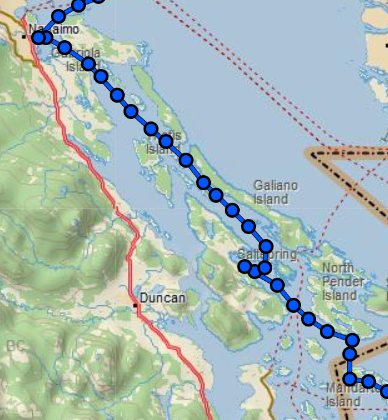
Reid Harbor, into Canada, Ganges, Dodd Narrows, and into Nanaimo.
• Strait of Georgia
All the water from Haro Strait, Boundary Pass, and Rosario eventually feeds into this long, wide strait—roughly 135–150 miles one and 20–25 miles depending on where you measure. With that kind of fetch, wind has plenty of room to build waves, and things get especially nasty when current runs against the wind.
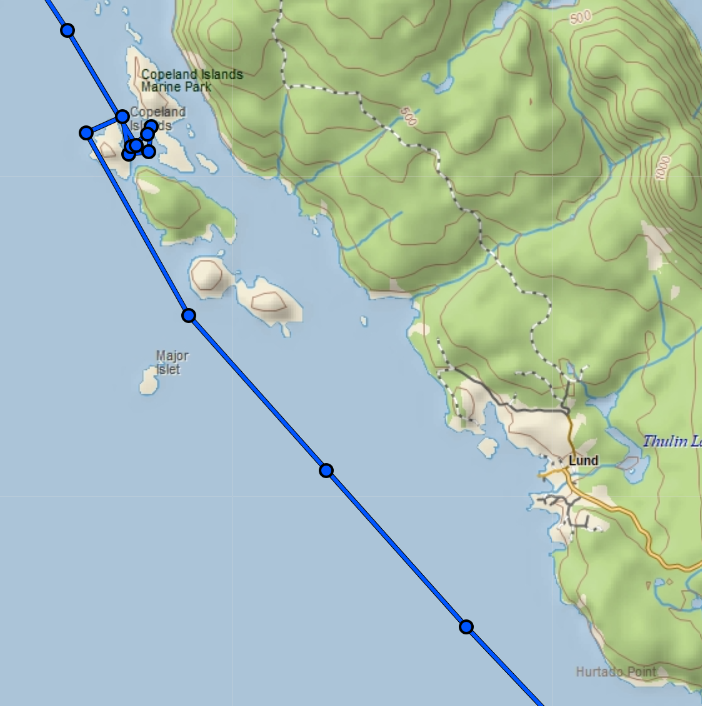
Our first 2024 crossing to Jedediah Island was calm and easy. The next day, though, I expected a fun 20–25 knot tailwind ride to the Copeland Islands and forgot to check the current. We got hammered by choppy seas until we regrouped (sponsored by the strait rounding us up), reefed, and settled the boat down. That event was more about hubris on my part than lack of knowledge.
Last year we had a beautiful crossing from Nanaimo to Smuggler Cove on a close reach in 15–20 knots. This year we headed south on a broad reach toward Howe Sound to meet a friend teaching a class. Sailing into Howe Sound for the first time—and getting that close to Vancouver—was a thrill. The sailing is great there, though anchorage options are limited at first glance. Next time we’ll definitely book ahead at Snug Cove Marina.
The next day we headed partway up Jervis Inlet and spent the night at Backeddy Marina. We’d hoped to time the rapids at Skookumchuck Narrows, but the marina only had space for one night, so the timing didn’t line up. We also toyed with the idea of running up to Princess Louisa Inlet, but that would have added another three days—and our priority this season is exploring the islands from Bella Bella to Prince Rupert. Backeddy, Skookumchuck, and Princess Louisa will get their own dedicated trip someday. Laura might surf; I’ll be the one watching from a safe distance.
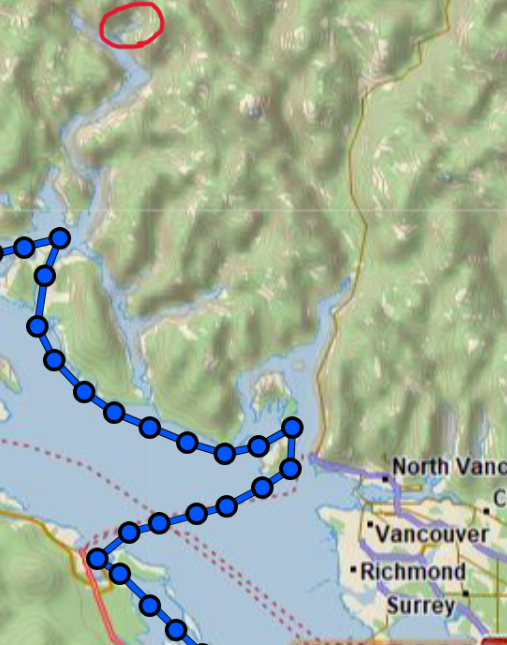
Nanaimo, Strait of Georgia, Howe Sound, Backeddy Marina.
Princess Louisa is the round circle at the top of the image, too far and bad timing for Malibu Rapids.
Make it stand out
From there we continued to the Copeland Islands.
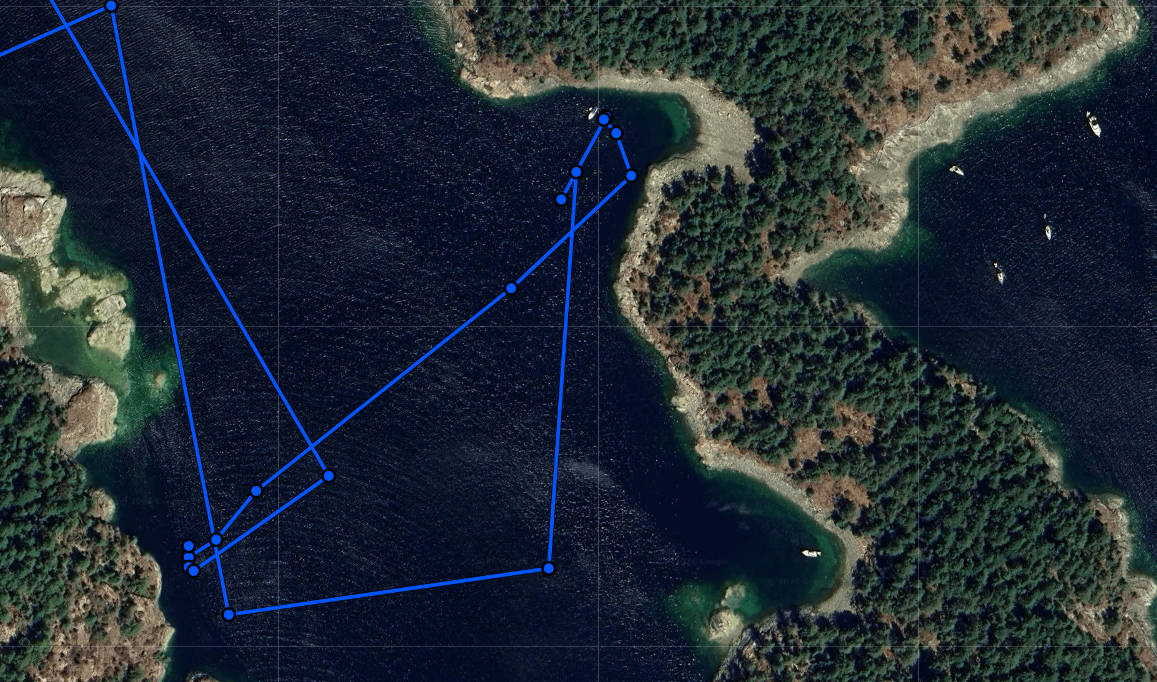
We first stopped there after our sporty Strait of Georgia crossing in 2024, but we’d arrived late and left early (the top right anchorage with several boats). We sterned tied in the two anchorages in the top middle and bottom left. This time we had two sunny days completely to ourselves, tucked in with a stern anchor in both spots. It was the perfect reset. I also got to test my new wetsuit—hood, booties, the whole setup—for the first time. It was fantastic to be warm enough to actually spend time in the water. I scrubbed the hull at the waterline and practiced using the weight belt so I can check the sail‑drive zincs on the next dive.
Laura had never visited any of the anchorages on Cortes Island, so we decided to see them all. Our first stop was Squirrel Cove, where we spent a quiet night. In the morning we dinghied over to the town and marina (see Instagram post)where there is a store, a single pump gas station, a food truck, and a place for rent. The store had a few provisions, but I knew the one in Gorge Harbour was excellent, so we zoomed back to Ardent, weighed anchor and headed around the south end.
We caught a little wind and tried to sail, but the current started dragging us south. As we pulled the sails in, I noticed we weren’t far from Mitlenatch Island—a remarkable nature reserve in the middle of the Strait of Georgia. With calm conditions and the island so close, we decided to detour. We were greeted (if you can call it that) by the resident Steller sea lion colony (see Instagram post). After their performance, the wind jumped from 0 to 15 knots in an instant, and we were able to sail the rest of the way into Gorge Harbour.
Gorge Harbour has a dramatic narrow entrance that opens into a large bay. The anchorage can be windy and is crowded with derelict boats, but we found a spot. The resort—run by the Klahoose First Nation—is fantastic. Beautiful grounds, a well‑stocked store, and Laura was able to replenish her salmon tackle right at the dock. Abigail, the friendly and helpful store manager from Cuba, told us they plan to reopen the restaurant next year. We’ll definitely be back.
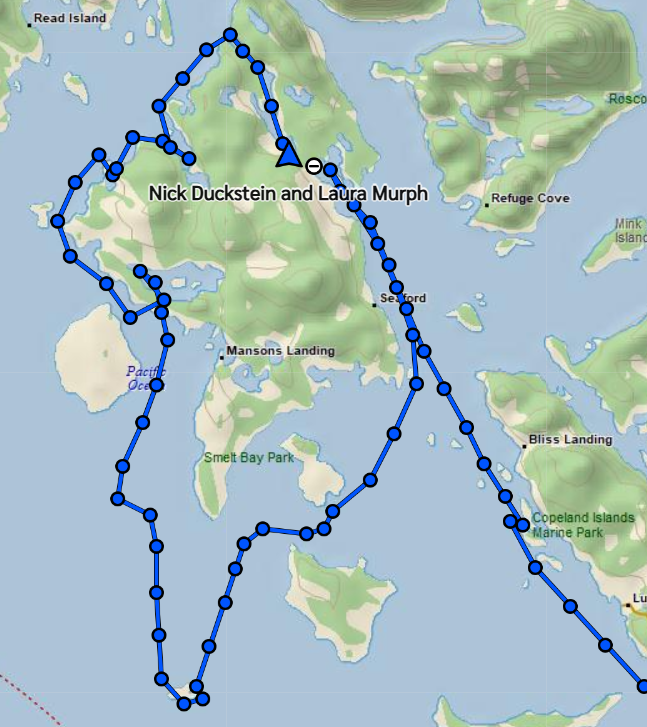
Circumnavigation of Cortes Island from the Copelands. First stop was in Squirrel Cove, then south to Mitlentach, Gorge Harbour, and Von Donop.
Which brings us to the last couple of days. We set a crab pot last night for the first time this year at the mouth of Von Donop, and we’ll see what kind of prizes it holds. The next big gate for us is Johnstone Strait—a 50–70 mile stretch, depending on where you start, and notorious for wind and waves if there are counter currents. There’s really nowhere to stop once you’re committed, so you wait for a good weather window and go. Ours looks like Monday: trailing winds, favorable currents, and rain. We’ve had nothing but sunshine so far—strange for May up here—but that’s about to end. After Johnstone, we’ll have about a week before the next window opens to round Cape Caution.