Ruminations from a windy winter on the dock in Anacortes
This year we decided to stay put in the Pacific Northwest and try living aboard through the winter. We toured several marinas—Friday Harbor and Roche Harbor were both contenders—but ultimately we weren’t quite ready for full island life. Cap Sante Marina in Anacortes became home.
Cap Sante is, in many ways, an ideal winter base. The docks are solid, the facilities are well run and when something breaks it actually gets fixed. Groceries, hardware stores, restaurants and coffee shops are all a short walk away. Trails weave through the surrounding hills and the gym was close enough that even on cold mornings we could talk ourselves into going. I had the benefit of riding my OneWheel and after a winter of riding my profiency increased dramatically. I did have one accident but I’m all healed up now.
But the wind. The wind in the transient slips is something else entirely. Being heeled over in 35–40 knots under sail is expected; being heeled over like that at the dock is not. We experienced that more than once and I’m fairly certain we won’t choose that particular winter setup again.
Fortunately, we weren’t on the dock the whole season. Thanks to our connections in the cohousing world, we were offered several house and pet‑sitting opportunities at Skagit Commons. We ended up spending about half the winter in that community. It was a gift—time to make friends, share meals and experience cohousing firsthand before we move into our own place in a couple of years.
My daughter Jensen joined us for a week, and together we headed to Seattle for the Super Bowl. I had never sailed into the city—or done much winter boating at all—so the trip felt like a small adventure. Most of the journey was spent motoring, but we did manage to raise the sails as we entered Elliott Bay. And of course, the Seahawks’ domination in that Super Bowl made the whole experience even more memorable.
Books, Weather, and the Quiet of Short Days
Winter’s short days meant long stretches indoors, and I’m endlessly grateful for libraries, Kindle, and good Wi‑Fi. Being able to download books without leaving my warm nook—and without needing to store physical copies we don’t have space for—is a luxury on a boat. It’s true in winter, and even more true when we’re cruising in remote places.
Still, the main reason we rely on Starlink while cruising is safety. The ability to download weather forecasts as often as needed has transformed life aboard. Not long ago we’d spend hours listening to VHF forecasts—broad, vague and often outdated. Now we can see dynamic weather models in real time, and that changes how we plan, how we move and how we stay safe.
The other safety benefit is remote troubleshooting. If something electrical goes sideways, our electricians can log into our system and diagnose the issue. This already saved us once—on our way south from Campbell River in 2024. With a decent connection, I can usually be walked through a temporary fix well enough to reach the next port where things can be properly repaired.
Those features protect our physical safety and our emotional equilibrium. The books, though—they feed my soul. Reading at anchor or on a winter night feels different than reading on land. The environment becomes part of the story.
Books I Read in 2025
My hope in sharing this list is simple: to find others who’ve read these and want to talk about them. I’m not a fast or patient reader; I manage maybe 1–2% of a book per day before my body insists I get up. Laura reads three or four times as many books as I do. Yet I’m always surprised by what happens when I move through life like a tortoise—slow, steady, persistent.
The Reactionary Spirit — Zach Beauchamp
The Creative Act: A Way of Being — Rick Rubin
Leaving
Why We Sleep
Out of Africa
Let’s Pretend This Never Happened — Jenny Lawson
The Daily Stoic
The Road Less Traveled — M. Scott Peck
One Hundred Years of Solitude
Love in the Time of Cholera
Die With Zero
Infectious Generosity
How to Know a Person — David Brooks
All the Light We Cannot See
The Sum of Us — Heather McGhee
Us — Terry Real
Crucial Conversations — Kerry Patterson
Entangled Life
Hamilton
Poor Charlie’s Almanack — Charlie Munger
Munger’s obsession with mental models fascinates me—the idea that learning the three big ideas from each major discipline gives you a toolkit for navigating the world. Of his twelve disciplines, I’ve only read these so far:
The Selfish Gene — Richard Dawkins
Basic Economics — Thomas Sowell
A Small Galley Evolution
Last fall we had a custom cutting board made to cover our stove so we could switch to an induction cooktop exclusively. It’s been a great decision—we haven’t used propane since early November.
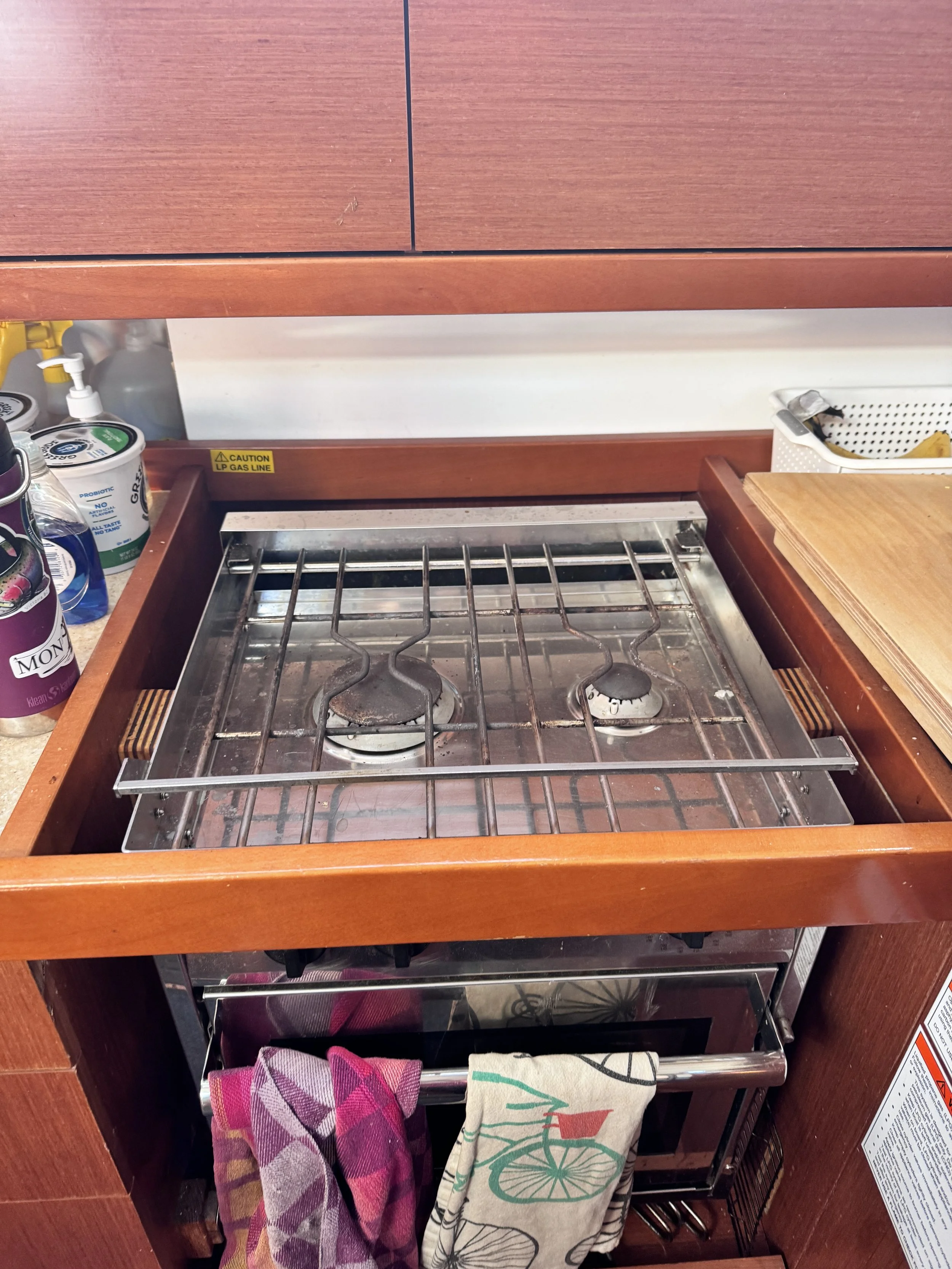
Before…
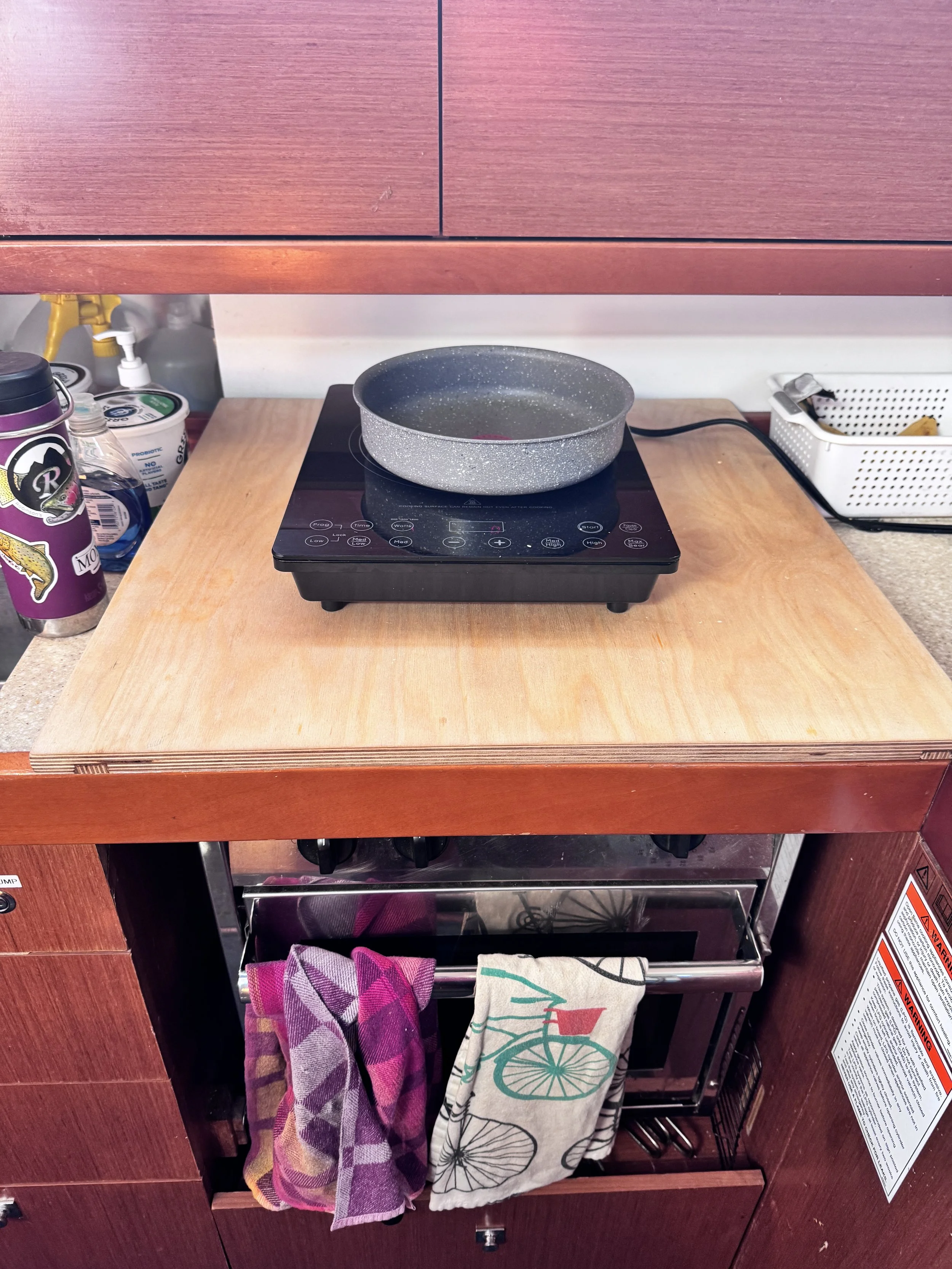
After…
We also added a small air fryer for bigger meals, letting us cook two things at once. It doubles as a wind‑proof, flame‑free barbecue that won’t threaten the bimini or require the usual contortions to reach under the transom seat to turn on the propane. It draws a lot of power, but that’s exactly what lithium batteries are for. Not having to worry about finding places to fill up with propane in remote places, carrying small bombs on board (which propane is), or finding new fittings due to corrosion is one less thing to worry about.
Everything worked great while plugged into shore power on the dock but we were not sure how things would work under way and so far so good. Under motor, the high‑output alternator charges batteries quickly. At rest or under sail, 800 watts of solar—paired with the surprisingly consistent sunshine thus far—has been more than enough.
Closing Reflection
Living aboard through a Northwest winter wasn’t always comfortable, but it was clarifying. The wind taught us what we don’t want to repeat. The cohousing community reminded us of the kind of connections we do want to cultivate. The books kept my inner world warm when the outer world was cold. And the boat—quirks, upgrades, and all—proved again that a small space can hold a full life.